
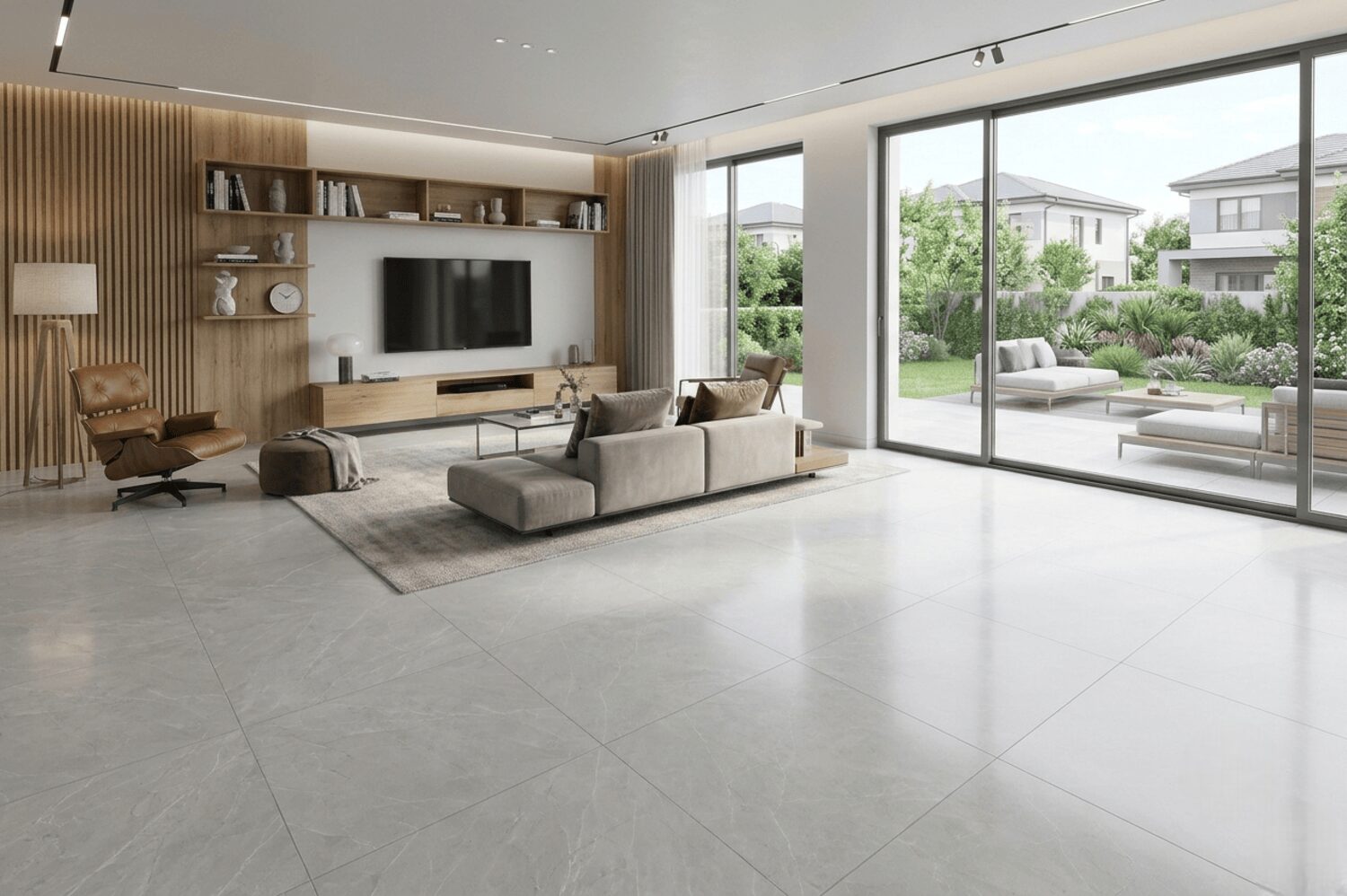
Diamond-saw cutting after firing to make perfectly straight cuts at 90° angles. Unlike pressed tiles that have rounded edges, rectified tiles have sharp corners and are all the same size. This mechanical precision enables a tile installer to install a tile with something as thin as ultra-thin grout lines, as thin as 1.5mm, to give a seamless, unbroken, luxury look to modern floors and walls.
What Will You Learn in This Rectified Tiles Guide?
In today’s world, selecting the appropriate tile edge profile is as important as the tile surface finish or pattern in a residential or commercial interior renovation. Conventional factory-fired tiles have a slight amount of shrinkage and edge variation during curing, leading to small dimensional variations that need large grout joints.
This hands-on guide will teach you how the tile rectification process works, why rectified tiles are better for interior seamless designs, how they differ from the standard pressed edge tile, and some key tips to consider when installing them.
What Is the Rectification Process in Tile Manufacturing?
The conventional process for making ceramic and vitrified tiles involves molding the clay bodies and firing them at high temperatures. Raw tiles get slightly rounded and become slightly uneven at the edges as the moisture is removed from within the kiln.
- Precision Mechanical Trimming: Precision diamond-tipped blades trim the tiles after firing and cooling in an automated grinding machine.
- Exact Dimensional Calibration: The blades remove edge irregularities so that each individual tile in a production batch is cut to the millimetre tolerances.
- Squaring the Corners: The Corners are grounded on all four sides to create a consistent tile slab with 90-degree, right angled corners, perfect for ultra-flush installation.
If you’re looking for advanced collections of vitrines and porcelains with a high level of precision produced in the factory, try the Avalta Granito.
Rectified Tiles vs. Standard Non-Rectified (Pressed) Tiles
Understanding the key physical and installation differences between rectified and standard non-rectified tiles helps you select the ideal option for your space:
Feature / Metric | Rectified Edge Tiles | Non-Rectified (Pressed Edge) Tiles |
Edge Finish | Machine-cut, sharp 90-degree straight edges. | Soft, slightly rounded, natural pressed edges. |
Grout Line Width | Ultra-thin joints (1.5mm to 2mm). | Standard wide joints (3mm to 5mm). |
Visual Effect | Continuous, slab-like, seamless appearance. | Distinct grid-patterned tile layout. |
Subfloor Requirement | Requires a perfectly flat, level subfloor. | Accommodates minor subfloor unevenness better. |
Ideal Applications | Modern living rooms, open-plan areas, feature walls. | Traditional spaces, rustic designs, outdoor patios. |
To examine diverse tile categories, from glossy porcelain to carving and matte series, explore the Avalta Granito Catalogue.
Why Are Rectified Tiles So Popular in Modern Interior Design?
The excellent visual and functional properties of rectified porcelain and vitrified tiles make them a popular choice for interior designers and architects in modern homes and buildings:
- Ultra-Narrow Grout Lines: Rectified tiles have the smallest grout joint spacing, which is only 1.5mm, resulting in a smaller visual break in the room, thus making the room appear larger, brighter and more spacious.
- Seamless Luxury Aesthetics: Used in combination with a grout that matches in color to the tile, rectified marble-look, stone or bookmatched tiles will give the appearance of a single piece of natural stone.
- Hygienic & Easy to Maintain: Narrower grout joints prevent dirt, grease and moisture from building up, and floors and bathroom walls are much easier to wipe down.
- Flawless Pattern Continuity: Complex pattern alignment, continuous veining and 3D geometric designs can seamlessly match up across adjacent tiles, with flawless Pattern Continuity ensured by precise dimensions.
To learn more about high-performance vitrified flooring options, read our complete guide on GVT vs PGVT Vitrified Tiles.
Important Installation Rules for Rectified Tiles
Rectified tiles have sharp ninety degree corners and no edge bevel, which means that if they are not properly installed, lippage (unevenness) occurs—one tile edge rides higher than its neighbor.
- Subfloor Preparation: Make sure that the concrete slab or wall substrate is completely level and flat for adhesive to be applied to.
- Never Install Butt-Jointed (Zero-Grout): A minimum grout joint of 1.5mm should be required to enable any natural building movement and thermal expansion.
- Use Tile Leveling Clips: Use a tile leveling system to provide leveling of adjacent tile edges to ensure flush tile during installation while the mortar sets.
- Select Flexible Polymer Mortar: Use a polymer modified adhesive to apply with high bond using a back buttering method for 100% coverage under large format tiles.
For direct assistance with tile manufacturing standards, international supply, or technical queries, Contact Us.
Frequently Asked Questions
Can rectified tiles be laid without any grout line?
Rectified tiles butt-jointed (with no grout gap) should not be laid. The natural expansion and contraction of buildings are caused by changes in temperature and humidity. The smallest acceptable grout joint is 1.5mm to 2mm, which will allow for flex over time to avoid cracking or tenting of tiles.
Are rectified tiles more expensive than standard tiles?
Yes, rectified tiles tend to be a bit more expensive, because they undergo an extra mechanical grinding during the production process. But that polished and upscale finish and lower maintenance of grout still provide a long-term benefit for modern interiors.
Are rectified tiles harder to install?
Yes. The best way to install rectified tiles is to hire an experienced professional tiler to do the job for you. The sharp edges have no margin for error, and it is important that the subfloor be perfectly flat, and that no clips have any lip variation when installing the subfloor.
Can rectified tiles be used on both walls and floors?
Absolutely. Rectified tiles are popular for use on interior floors and walls. They’re particularly favored in contemporary bathrooms, living rooms, hotel lobbies, and kitchen backsplashes where a clean and streamlined look is appreciated.
Key Takeaways for Using Rectified Tiles in Your Space
Rectified tiles are the great option to give sleek, modern and uninterrupted appearance in modern residential as well as the commercial spaces. The machine-cut edges and ultra-thin grout lines provide the luxury of seamless stone slabs combined with easy maintenance. When it comes to making your rectified tiles look beautiful for the long haul, always choose a subfloor that has been perfectly prepared, and get the tile layer to install it. Take your interior design ideas to the next level with accuracy-made tile options!